Video Model
RoboRender adapts Wan2.1-T2V-1.3B into a robot-oriented renderer, fine-tuned on ~130k real robot manipulation samples (~70k from AgiBot-World-Alpha, ~60k from DROID) at 416×240 — see Training data for the corpus and how it was built. The model is trained on real video and only conditioned on simulation at generation time.
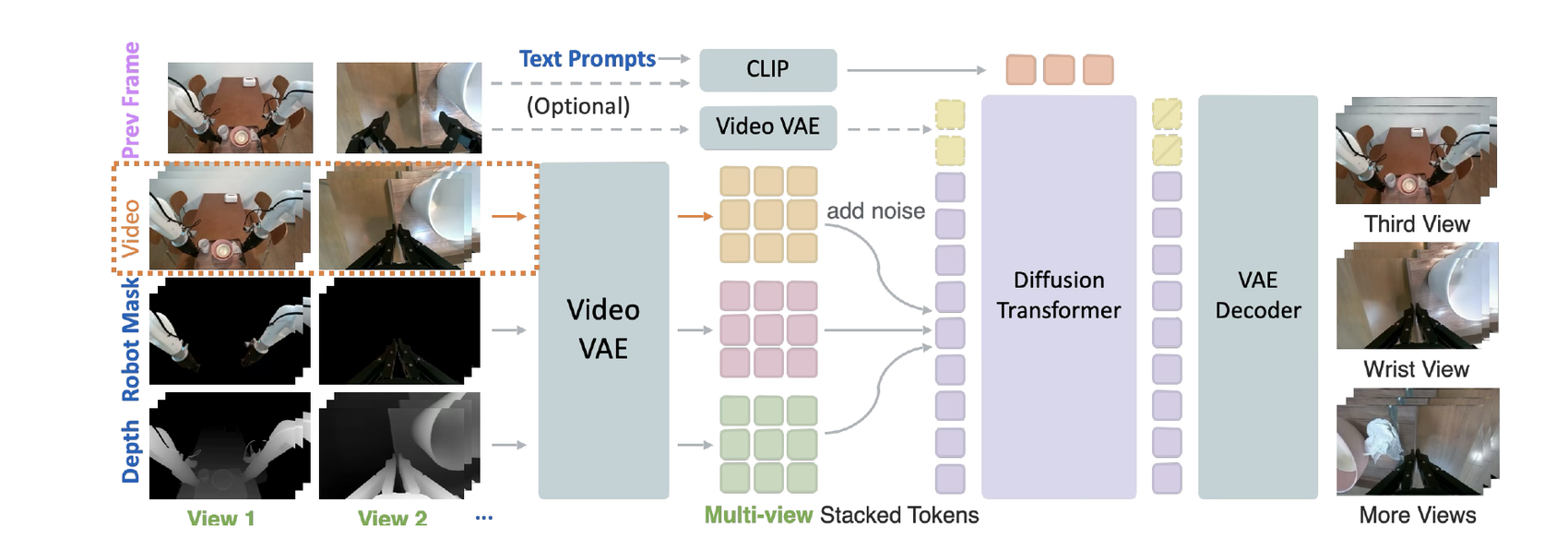
What the model can do
- Multi-view consistency. Views are stacked into a unified multi-view latent rather than generated independently, so shared objects stay consistent across the external and wrist cameras.
- Long-horizon rollouts. Generation is autoregressive: each chunk is conditioned on the previous chunk's last frame, so variable-length demonstrations can exceed the model's fixed frame window.
- Cross-embodiment generation. Robot-mask conditioning lets the model render embodiments it never saw in training — both the R1Pro used for mobile manipulation and the YAM arm are unseen during video-model training.
Rendering cost
Rendering a whole simulation dataset takes many diffusion passes, so inference cost bounds how much data you can generate. Two optimizations bring it down:
- TeaCache — reuses intermediate diffusion features across denoising steps. A 3-view 81-frame clip drops from 68.8 s to 35.3 s on a single H200, a 1.95× speedup at negligible quality loss.
- DMD2 step distillation — reduces the 50-step bidirectional sampler to 6 steps. The distilled model renders a 3-view clip in 4.29 s.
Existing robot datasets are collected for policy learning, not video generation, so they lack the prompts, geometric conditions and embodiment signals this model needs. Our preprocessing pipeline turns existing demonstrations into training-ready samples: for each clip we take a temporally consistent 81-frame window across all camera views and derive four aligned conditions.
Scene prompt
A vision-language model runs in two passes: a draft caption from the first frame, then a refinement that cross-verifies objects across all non-wrist views. Constraining the output to structured metadata cuts hallucination substantially versus single-pass captioning.
Per-view depth
Video-Depth-Anything for all samples, plus FoundationStereo where stereo recordings exist, both normalized by inverse-depth mapping. Depth sources are randomly mixed per view during training, so the model does not inherit the bias of any single estimator.
Robot arm RGB and masks
SAM3 segments the arm and gripper across every view, isolating the agent's pose and motion from the rest of the scene so embodiment can be varied independently of the background.
Preceding frame
The frame immediately before the 81-frame window. This is the temporal conditioning the model chains on at generation time to run rollouts past its fixed frame window.
Distribution of the 16 task types across the training corpus. Hover a slice or a row for its sample count.
| Source | Samples | Distinct scenes | Task categories |
|---|---|---|---|
| AgiBot-World-Alpha | 69,910 | 22,650 | 10 |
| DROID | 57,040 | 17,042 | 15 |
| Total | 126,950 | 39,692 | 16 |
Distractors are inserted by cropping the condition, not the scene. Temporally consistent rectangles are punched out of the simulation depth map — the black patches below — so those regions are no longer pinned to simulated geometry, and the model fills them with clutter from the prompt: stable over time, and clear of the geometry the task depends on. For DROID pick-and-place we crop 2–5 patches covering 20–50% of the external view and 1–2 in the wrist view.
We evaluate on 500 held-out clips from the real training corpus (DROID and AgiBot), under two inference-matched settings: first-chunk generation, which runs without previous-frame conditioning, and autoregressive continuation, which is conditioned on a ground-truth previous frame. The baselines are three depth-conditioned video generators — Wan-Fun-Control, Cosmos-Transfer2.5 and RoboTransfer. The clips below show a qualitative comparison against the first two.
Open the fridge
Open the drawer
Quantitative results
| First-chunk | AR continuation | ||||
|---|---|---|---|---|---|
| Model | FID ↓ | FVD ↓ | PSNR ↑ | SSIM ↑ | LPIPS ↓ |
| Wan-Fun-Control | 62.5 | 267.8 | 20.30 | 0.738 | 0.175 |
| Cosmos-Transfer2.5 | 42.8 | 164.5 | 13.26 | 0.481 | 0.423 |
| RoboTransfer | 52.8 | 275.4 | 13.75 | 0.509 | 0.418 |
| RoboRender | 25.7 | 93.9 | 22.28 | 0.784 | 0.142 |
Per-frame PSNR and LPIPS along 15-second autoregressive rollouts, sampled every 3 seconds — quality holds up across the repeated steps needed to render a full trajectory.